

Seeking a Simpler Life
Wondering if it's even possible.

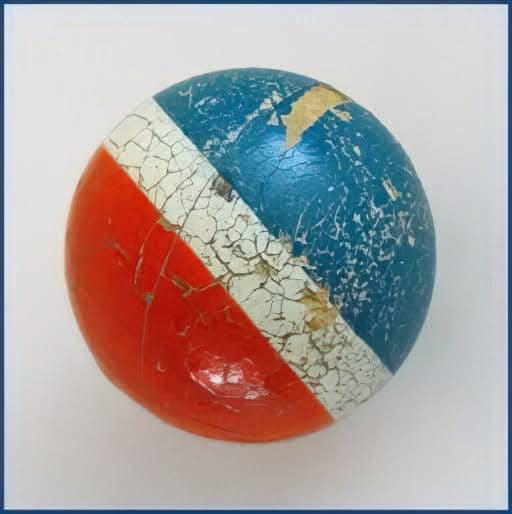
The ball cost maybe a dollar, if that. Red, white, and blue foam—the colours bleeding into one another divided by a perfect white strip—a Pepsi ball, like a promise of something sweeter. It fit perfectly in the palm of my hand, light as air, yet weighted with possibility. When it was new, the paint was slick, almost wet-looking, and the foam had a firm give, like pressing your thumb into a ripe peach. It bounced true. You could trust it.
We didn’t have much in those days, but almost every kid had that ball.
The laneways of my childhood were narrow corridors of cracked concrete and chain-link fences, bordered by garages with peeling paint and back doors that slammed with the particular percussion of homes too full of people and not enough room for the feelings inside them. We gathered there—me and the other boys from the block—our bicycles leaned against walls or tossed on patches of brown grass, our sneakers worn through at the toes. There were no phones in our pockets, no screens to scroll. If you wanted to find someone, you walked to their house and knocked, or you stood at the end of their laneway and called out their name until they appeared.
The Pepsi Ball was our currency, our common language. It was a precursor to the tennis ball. With it, we invented worlds. It became a baseball for games of catch against the side of a garage, the satisfying thwack of foam against aluminum siding echoing between houses. It became a soccer ball for makeshift matches in backyards where the goals were two rocks or a pair of overturned milk crates. It became a basketball for games of horse, the hoop a rusted rim nailed above a garage door, the net long since rotted away.
We played a game called Spot—throwing the ball at a set of stairs, trying to hit the edge just right so it would arc back to you in a clean catch. Miss the edge, hit the flat, and the ball would dribble uselessly to the ground. But catch that edge? The ball would sing back to you like a reward for precision, for patience. We spent hours on those concrete steps, the late afternoon sun stretching our shadows long and thin behind us, the air thick with the smell of cut grass and someone’s mother’s cooking drifting from an open kitchen window.
And then there was the garage door. Alone, when the other boys had gone in for supper, I’d stand in the laneway with that ball and bounce it. One bounce, two, between the legs, clap. The rhythm of it, the repetition, became a kind of meditation, though I didn’t know that word then. I only knew that the world shrank to the size of that ball and the sound it made—a soft, hollow pop against the pavement, the louder thud against the metal door. Everything else fell away and I needed it to.
The ball didn’t last, of course. Nothing ever does. Over time, the paint began to crack, splintering into a web of fine lines, then flaking off in patches that left the foam exposed—pale and vulnerable, like skin beneath a scab. The dogs in the neighbourhood got to it, their teeth puncturing the surface, tearing off chunks of foam that left the ball pocked and misshapen. Still, we played with it. We played until it was half its original size, lopsided and grey, until it no longer bounced true but wobbled and careened unpredictably. Even then, even ruined, it served its purpose.
I think now about why that was. Why we clung to that tattered ball long past its usefulness. And I understand it had nothing to do with the ball itself.
The homes we came from were not easy places. I don’t say this for pity—it was simply the texture of our lives, as unremarkable to us as the telephone and hydro wires that crisscrossed above the laneways or the Queen Anne’s lace that grew wild in the vacant lot on the corner. Our fathers worked jobs that broke their backs and sometimes their spirits—factory shifts, construction sites, loading docks. They came home with their shoulders knotted and their patience thin, and sometimes the drinking started before dinner was on the table. Our mothers moved through those houses like ghosts, trying to keep everything together with hands that were never still.
There was yelling. There was silence that was worse than yelling. There was the particular tension of not knowing whether the front door opening meant an ordinary evening or something else entirely. We learned to read rooms the way other children learned to read books—quickly, scanning for danger, adjusting ourselves to fit whatever shape was required of us.
We knew what was happening in each other’s homes. We never spoke of it.
This was an unspoken covenant among us, as binding as any blood oath. When Paulo showed up at the laneway with red-rimmed eyes, no one asked why. When Ricky flinched at sudden movements, we pretended not to notice. When I couldn’t go home until the lights in the kitchen went off, the other boys kept playing with me, kept passing the ball, kept the game going until it was safe.
That ball wasn’t just a toy. It was a shield. A portal. A way of being together in our difficulty without having to name it. Every game was an act of collective forgetting, and also, strangely, an act of witnessing. I see you. I know. Here, catch.
I am fifty-nine years old now, and I find myself wanting one of those foam balls again.
Not for nostalgia’s sake—or not entirely. But because the world has grown so loud, ugly in its politics, short on humanity, so relentless, so much, and I have lost the ability to make it small again.
I worry about my boys. They are grown, but the worry doesn’t shrink with —it expands. I worry about their safety in a world that feels more precarious than the one I navigated, more volatile, more uncertain. I worry about their hearts and their health and the things they carry that they don’t tell me about, because I understand now that children never tell their parents the full truth of their inner lives. I didn’t. They won’t. This is the way of things, and still it keeps me up at night.
I worry about writing. This vocation I’ve given my life to—the books, the stories, the constant reaching for something I can’t quite name. Publishing is a brutal industry, indifferent at best and cruel at its worst, and I have never learned to let rejection slide off me the way water slides off stone. Each “no” lands like a fist. Each silence stretches like an accusation. And yet I keep writing, because I don’t know how not to, because the stories insist on being told even when no one is buying what I’m selling.
Just ltoday, we got a new washer and dryer delivered. A simple thing, a domestic errand, the kind of task that should be unremarkable. But nothing went right. The delivery was delayed, then rescheduled, then the men who finally arrived couldn’t fit the machines through the basement door. There was measuring and arguing and phone calls to the store and the particular humiliation of standing in your own home feeling helpless while strangers shake their heads at your infrastructure. Eventually it got sorted. It always gets sorted. But I was undone by it the whole time leading up to their arrival and the whole time they were here fiddling with things. My chest tight, my thoughts spiralling, my sleep fractured.
Why? Why does this small chaos rattle me so deeply now when, five years ago, I would have shrugged it off? What has happened to me?
I think the answer is that the years accumulate not just in our joints and our grey hair but in our nervous systems. Every crisis weathered, every loss absorbed, every fear swallowed down instead of spoken—they leave residue. Scar tissue. And eventually there’s so much scar tissue that the smallest friction feels like a wound.
I used to be able to make the world small. To shrink it down to the size of a foam ball bouncing against a garage door, to the rhythm of one bounce, two, between the legs, clap. The repetition was a kind of magic, a spell against everything that felt too big to hold. Now the world refuses to shrink. It presses in from all sides—the news, the screens, the pings and notifications, the endless scroll of other people’s lives and opinions and catastrophes. My mind has forgotten how to do the one thing it knew so well in those laneways: how to focus on a single bouncing ball and let everything else fall away.
I wonder sometimes if I can get back there. To that laneway, to that garage door, to that quiet.
The boys I played with are scattered now—some still in the neighbourhood, some moved away, some gone in ways we don’t talk about, because we never learned how to talk about the hard things and we’re too old now to start. But I think of them. I think of the way we held each other’s pain without ever naming it. The way the ball moved between us, carrying everything we couldn’t say.
Maybe that’s what I’m looking for. Not the ball itself, but what it represented. A way of being present in the difficulty. A way of passing the hard things back and forth until they become, if not lighter, at least shared. Maybe what I need is not simpler, but smaller. One bounce at a time. The focus of a single repetitive act. The faith that if I keep bouncing the ball, keep hitting that garage door, the rhythm will eventually quiet the noise.
I don’t know if I can get back to that place. But I know I have to try.
As your fellow novelist wrote, “You Can’t Go Home Again.” I wonder if life is ever simple.