

The Mexico Chronicles - Part 2
A realization about the important things in my life.

The bus pulled away from the terminal in Mexico City with the slow, patient sigh of a creature accustomed to long journeys. By then my boys and their girlfriends were already somewhere above the clouds, winging their way north, back toward their work schedules and winter coats and the dependable grayness of home. My wife and I stood for a moment beside the idling bus before climbing aboard, the city stretching around us in every direction, vast and humming.
For this leg of the trip, it was just the two of us.
Mexico City had given us more than we expected. It had been a city of texture—stone and color and movement layered over centuries. We had wandered through neighborhoods where some early jacaranda blossoms were opening above crumbling sidewalks, through markets where pyramids of fruit glowed under bare bulbs, into museums where the past felt less like history and more like something breathing quietly beside you
Everywhere there had been generosity.
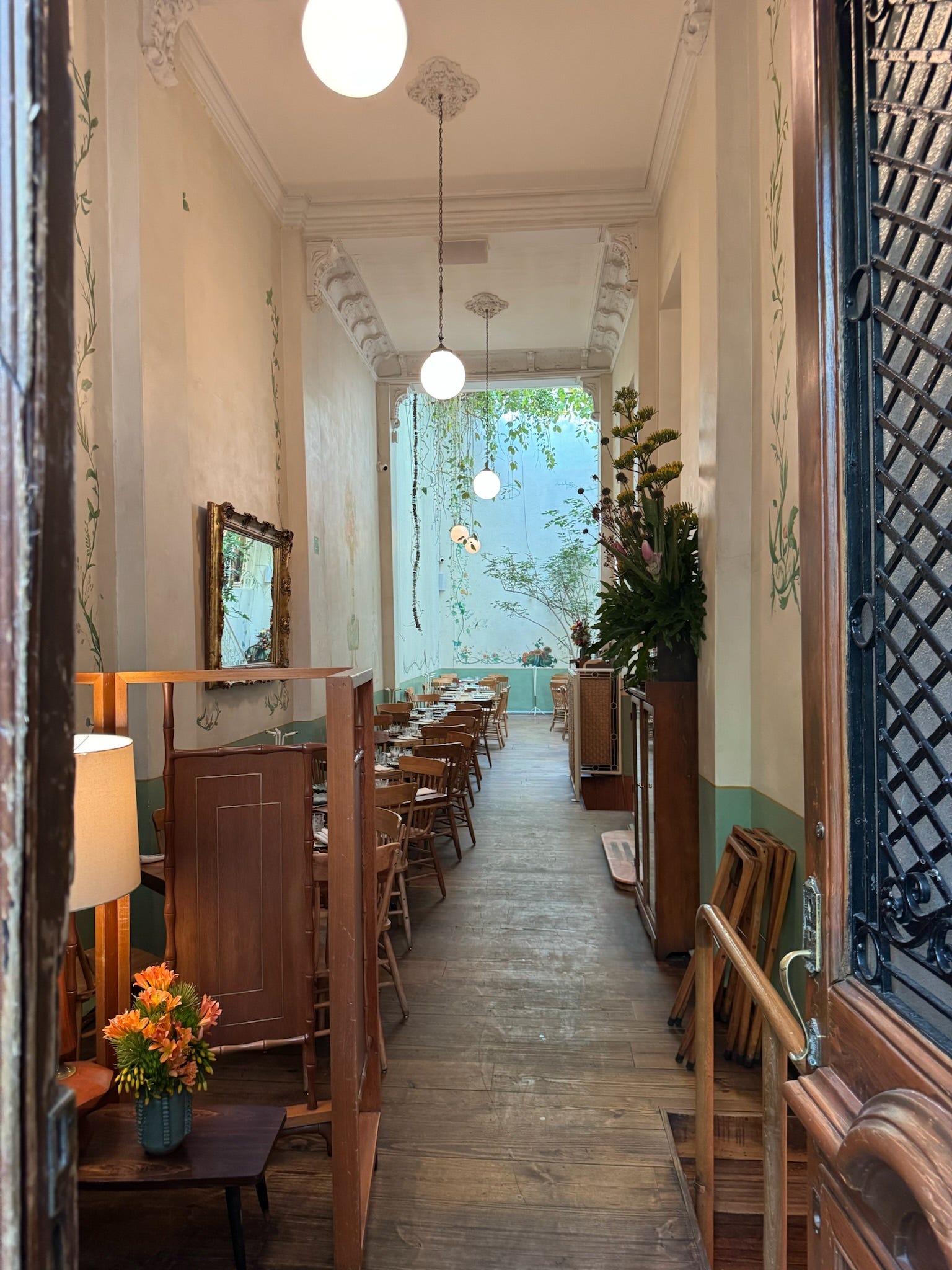
A waiter in Polanco insisting we try the aguachile — a popular, spicier, and faster-marinated, Sinaloa-style variant of ceviche. A woman in Rosetta bakery slipping an extra concha into my bag with a conspiratorial smile. An Uber driver who, discovering we were Canadian, began by welcoming us into his car and offering personalized tours of the city.

The city had an energy that refused to sit still.
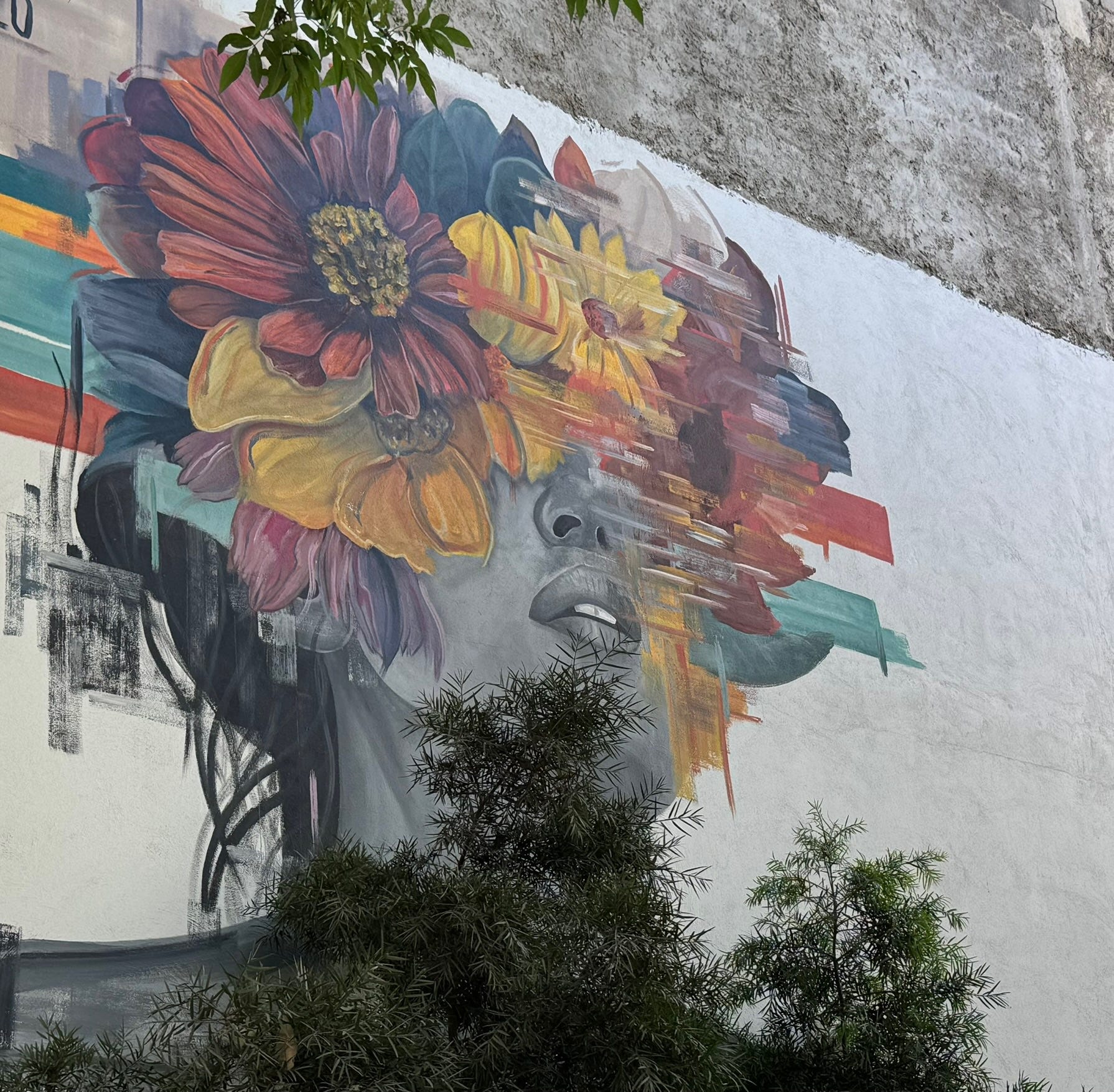
Food stalls steamed on corners beside sleek design shops. Murals climbed entire buildings. Music seemed to leak from every doorway. And always there were people—talking, laughing, arguing, living out loud in a way that felt both chaotic and deeply human.
The morning we boarded the bus bound for San Miguel de Allende, the highway slipped us gradually out of the capital’s sprawl. Concrete towers gave way to low neighborhoods, then industrial edges, and finally the open sweep of central Mexico. Dry hills rose and fell beneath a large sky so inexplicably blue.
Travel has a way of slowing the mind. Hours pass without expectation. You begin to notice things: the rhythm of roadside towns, the color of the soil, the way the light moves across the land. There is something about fences and boundaries, those markers of clear delineation that clearly divides land and people . . . that suggests ownership of place. I focus on the materials they use to create fences—weathered wooden posts with wire (once taut) now sagging slightly.
We were about an hour from San Miguel de Allende when the bus slowed. At first it was subtle—a hesitation in speed, the gentle drift toward the shoulder of the highway. The driver spoke briefly into a radio, then eased the vehicle to a full stop. Passengers stirred. A pee break, perhaps? The driver stood, clearing his throat with the careful authority of someone accustomed to delivering news that might unsettle people. He explained calmly that there had been unrest in Puerto Vallarta—far from where we were—but the federal government had issued temporary highway closures across several provinces. As a precaution, buses were being rerouted off major roads until authorities confirmed it was safe to proceed. He informed everyone that we would be heading to Querétaro to wait for further instructions. When asked how long he thought that might be, he wouldn’t venture to respond.
There was no panic on the bus. Although one elderly couple kept insisting they be provided with more information, clearer directives from the bus company. It never ceases to amaze me how there is always that one person that insists and demands and simply can’t allow for a quiet shifting of plans. If anything, travel teaches patience in ways ordinary life does not. When you are far from home, you surrender more easily to circumstances. There is an unspoken understanding that the road, like life, does not belong to you.
The bus terminal in Querétaro was a world unto itself when we arrived. It was packed. Rows of buses lined the platforms like stranded ships, each having been pulled from the highways and deposited here to wait. The terminal hummed with voices—families gathered around suitcases, travelers pacing with phones pressed to their ears, vendors weaving through the crowd selling coffee and sweet bread. Every seat seemed occupied. Announcements crackled overhead in rapid Spanish. My wife and I found a small patch of wall to lean against and set our bags at our feet. There was nothing to do but settle in. No need to stress. I bought coffee from a kiosk and watched the choreography of the station unfold. That’s what writers do; we observe those things that others might overlook—the way a worried mother holds her child’s hand, how the man beside me dug the tiniest of combs out of his pocket to rake his mustache, the way a woman ate a sandwich—going at the insides until only the crust remained to be discarded.
Time stretched and in the age of instant information, waiting always invites curiosity. Soon enough we were reading the Globe and Mail news on our phones, trying to understand the ripple effect that had landed us here. The unrest traced back to the death of a man whose name had haunted headlines for years: Nemesio Rubén Oseguera Cervantes. Better known as El Mencho. He had been the leader of the Jalisco New Generation Cartel, one of the most powerful and feared criminal organizations in Mexico. For years he had lived like a shadow—rumored here, spotted there, always just out of reach of authorities. One of the most wanted men in Mexico. One of the most wanted in the United States. And now he was dead.
The story of how they found him read almost like fiction. After years of failed attempts, investigators had reportedly tracked him through someone close to him—a lover whose movements eventually revealed the location of the man who had eluded capture for so long.
But death does not end power structures so easily. The cartel’s retaliation had been swift and theatrical in its violence: buses burned along highways, vehicles hijacked and set ablaze, roads blocked with flaming barricades. A show of force designed to spread fear more than anything else. Lives, as they so often do in these shadow wars, caught in the machinery of something larger than themselves. Reading about it inside the fluorescent calm of a bus terminal felt strangely distant. We were hundreds of kilometers away from the chaos. Here, people simply waited. A boy kicked a soccer ball gently between two plastic chairs. A woman braided her daughter’s hair. An elderly man dozed with his hat tipped forward over his eyes.
Life continued and the writer in me found himself fascinated by the human web behind it all—the idea that a man so powerful, so hidden, could ultimately be located through the oldest story there is: love. Or something resembling it.
Two hours passed. Eventually the announcements changed. Routes were being reopened. Authorities had cleared sections of the highway. Buses would begin departing again in stages. A ripple of relief moved through the terminal. Our bus number appeared on the departure board. We gathered our things and joined the slow procession back onto the platform. The driver, looking slightly more relaxed now, greeted us with a nod as we climbed aboard.
The sun had begun its descent when the hills outside the window shifted from dusty gold to something warmer—rose and amber tones catching on stone and rooftops. And then, suddenly, San Miguel de Allende appeared. Even from a distance it looked improbable. The city rose from the hills like something imagined rather than built. Everything seemed washed in a palette of earth—terracotta, ochre, soft coral pinks glowing under the late afternoon light. The bus wound through narrow streets paved with worn stone.
San Miguel is a UNESCO World Heritage site, though the designation feels almost unnecessary once you see it. The entire city seems arranged around beauty. Colonial buildings lean toward one another across cobblestone streets. Bougainvillea spills over walls in bright cascades of purple and red. Small plazas open unexpectedly, each one holding a fountain or shaded bench where locals gather to talk in the slow rhythm of evening. And above it all rises the Parroquia de San Miguel Arcángel, the city’s most recognizable landmark.
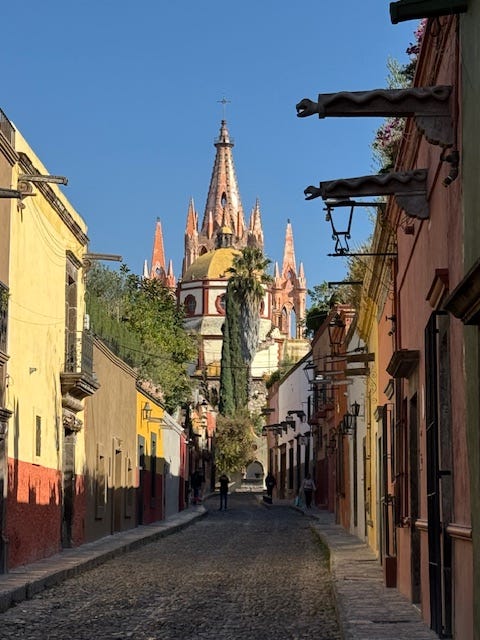
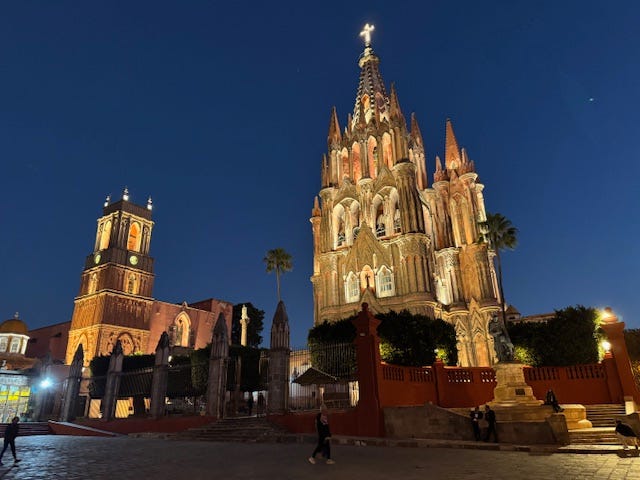
Its pink neo-Gothic spires look almost dreamlike against the sky, like something lifted from a fairy tale rather than carved from stone. Artists have been drawn here for decades. Painters, writers, musicians—people searching for a place where beauty and quiet might coexist with inspiration. Galleries line the streets. Courtyards hide studios filled with color and clay and unfinished ideas.
There is a softness to the pace of the city. Not slow exactly. But deliberate.
Our hotel sat tucked along a narrow street across from a city park. Its heavy wooden doors opened into a courtyard filled with plants and the soft sound of water trickling from a small fountain. After the long day of travel, the quiet felt almost luxurious. We dropped our bags in the room and stepped onto the large balcony overlooking the grounds. Evening had settled in, and somewhere nearby a guitar was being played softly, the notes drifting through the open air. While we relaxed and prepared to go out for dinner, our concierge, a lovely woman by the name of Lulu, was frantically trying to get us reservations at a restaurant, something close by. It was difficult because of the day’s events . . . so many establishments had closed for the day, worried the violence that was happening in Puerta Vallarta might spill into other areas where tourists gathered.
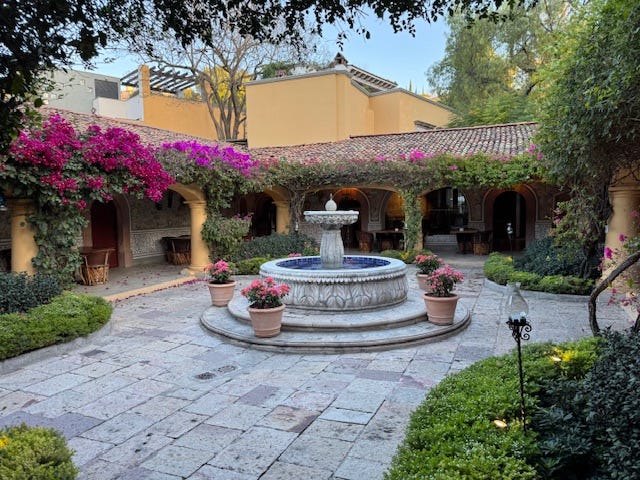
It is strange how quickly calm can return once you allow it. Only hours earlier we had been standing in a crowded bus terminal reading about violence and power struggles that seemed pulled from a crime novel. And yet here we were now, surrounded by flowers and stone and the quiet murmur of water.Travel compresses contrasts like that. It reminds you how wide the world really is.
Later that night we walked into the heart of the city. The central plaza was gentle—some families strolling beneath trees wrapped in tiny lights, a few daring couples sitting shoulder to shoulder on benches, a handful of vendors selling roasted corn brushed with lime and chili. Mass over a loudspeaker drifted from somewhere near the cathedral steps.
My wife slipped her arm through mine. Thirty years together teaches you a certain rhythm. Conversation becomes less necessary. Sometimes walking beside each other is enough. And there, in that quiet corner of San Miguel de Allende, I felt something settle inside me—an understanding that calm is not something you stumble upon.
It is something you choose.
You remove what doesn’t belong.
You protect what does.
And when you do that long enough, life becomes a little clearer.
A little kinder.
A little more like the soft, steady sound of water in a courtyard far from home.
Another lovely read Anthony. Your descriptions of the small details of ordinary people, their actions, along with a painterly eye to the landscape and other elements that surround you, transports me to where you are. Reading this is indeed an embodied experience! I noticed a small typo: I think you meant TAUT rather taught when you were describing the fence wires.
Love this so much. There is always that one person who demands more, so true and so true that choosing calm is a generous gift to oneself.